
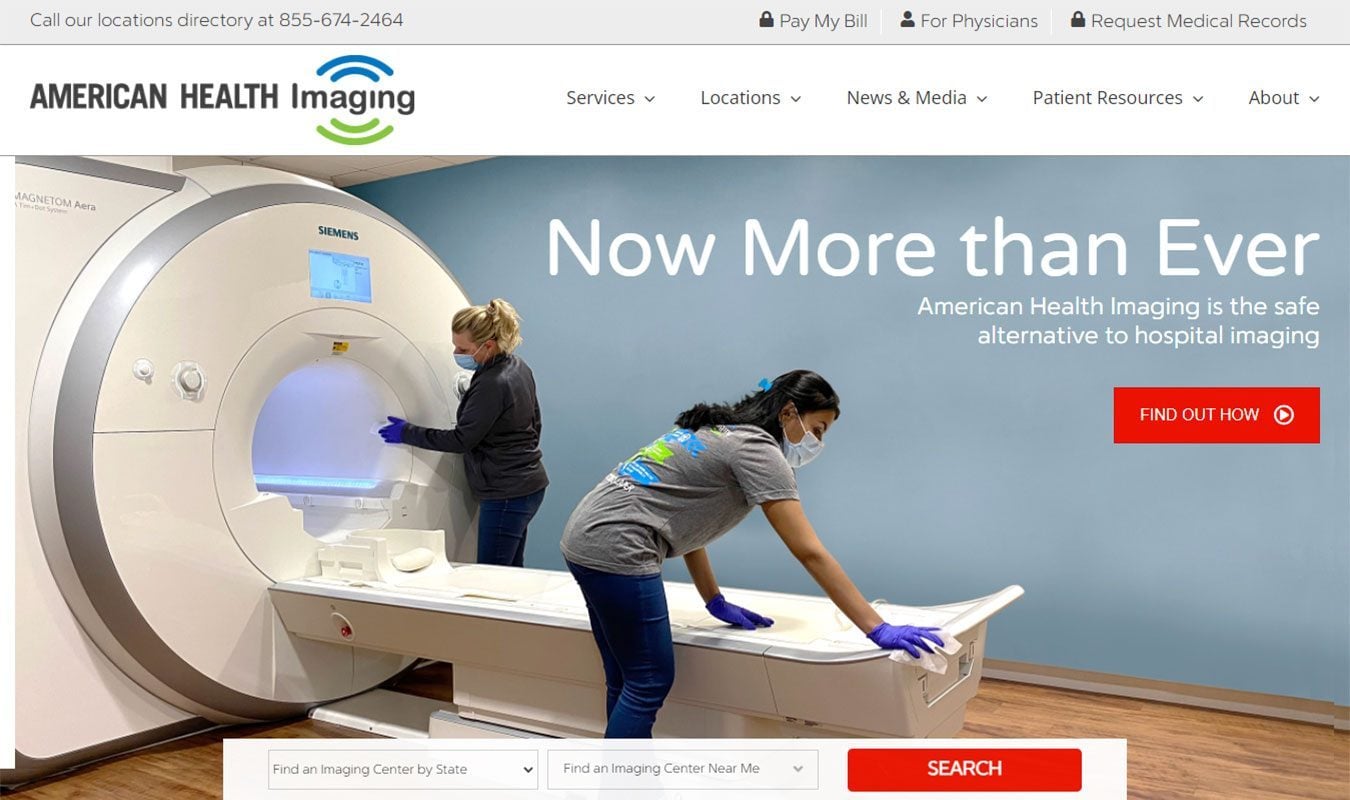
Website and Marketing Automation Transform Diagnostic Imaging Provider Into Patient-Centered Digital Experience Platform
Project Overview
American Health Imaging operates at the intersection of advanced diagnostic technology and patient-centered healthcare delivery—a multi-location radiology group with over 40 outpatient imaging centers across Georgia, Alabama, South Carolina, Texas, and Florida offering MRI, CT, ultrasound, X-ray, and specialized diagnostic services. Their value proposition challenges hospital-based imaging on three critical fronts: cost (60% less expensive), convenience (extended hours, same-day appointments, faster scan times), and quality (state-of-the-art technology, board-certified subspecialized radiologists).
In healthcare markets where patients increasingly function as healthcare consumers making location and cost-based decisions—particularly those with high-deductible insurance plans who bear significant out-of-pocket expenses—American Health Imaging’s competitive advantages (dramatic cost savings, convenient locations, superior patient experience) represent compelling differentiation. However, converting these advantages into patient appointments requires overcoming significant barriers: patients struggle to understand medical terminology when selecting imaging services, procedure costs remain frustratingly opaque creating decision paralysis, multi-location organizations face complexity directing patients to nearest convenient centers, and traditional healthcare websites fail to deliver consumer-friendly experiences expected from modern digital platforms.
When American Health Imaging engaged Code Conspirators, they confronted challenges endemic to healthcare service organizations transitioning from physician-referral dependent models to direct-to-consumer patient acquisition strategies: their existing website failed to convert visitors into appointment bookings at acceptable rates, patients couldn’t easily determine which imaging procedure they needed using confusing medical terminology, procedure cost transparency—their major competitive advantage—remained hidden or difficult to access, multi-location complexity created friction as patients struggled to find nearest centers, and traditional form-based interactions felt clinical and intimidating rather than helpful and accessible.
For an organization whose tagline “Choose You. See What’s Inside” emphasizes patient empowerment and transparency, their digital experience needed to embody those same principles through intuitive navigation, cost clarity, location convenience, and consumer-friendly interaction patterns. The challenge transcended typical healthcare website redesign—it required innovation in how patients discover appropriate services, marketing automation enabling intelligent user routing, and creative approaches to medical education that reduce barriers rather than reinforcing healthcare system complexity.
Code Conspirators partnered with American Health Imaging to engineer comprehensive WordPress website with sophisticated marketing automation—creating digital platform that automatically routes patients to nearest locations while using innovative “point to where it hurts” visual interface enabling non-medical consumers to identify needed procedures and understand cost implications through intuitive, empowering experiences.
The Strategic Challenge
Medical Terminology Barrier:
Patient Confusion:
Non-medical consumers don’t think in clinical terms. When experiencing symptoms, they don’t immediately know whether they need:
- MRI vs. CT scan
- Open MRI vs. traditional MRI
- Arthrogram vs. standard MRI
- Ultrasound vs. X-ray
- Specialized procedures (NeuroQuant, FibroScan, Diffusion Tensor Imaging)
This knowledge gap creates decision paralysis—patients know they have symptoms but can’t navigate service selection without clinical guidance, often leading to abandonment or defaulting to physician-directed hospital imaging.
Healthcare Cost Opacity:
Industry-Wide Pricing Secrecy:
Healthcare traditionally obscures pricing until after services render, creating anxiety and preventing cost-based shopping. American Health Imaging’s 60% cost advantage versus hospital imaging represents massive competitive differentiation—but only if patients can:
- Access pricing information easily
- Understand what specific procedure they need
- Compare costs with confidence
- Make informed decisions before scheduling
Without cost transparency at decision moment, American Health Imaging’s pricing advantage remains theoretical rather than conversion-driving.
Multi-Location Routing Complexity:
Geographic Challenge:
With 40+ locations across five states, website visitors require immediate answers to “Where’s the closest center that offers my needed service?”
Manual location searching creates friction:
- Users entering zip codes or addresses separately
- Browsing location lists trying to determine proximity
- Checking individual center service availability
- Navigating away to mapping applications
Each additional step reduces conversion probability, particularly for mobile users seeking immediate scheduling.
Healthcare Industry User Experience Expectations:
Consumer vs. Patient Disconnect:
Healthcare websites traditionally treat users as “patients” (passive recipients of provider-directed care) rather than “healthcare consumers” (active decision-makers shopping for services).
Modern consumers expect:
- Amazon-like ease of service selection
- Transparent pricing before commitment
- Immediate access to scheduling
- Mobile-optimized experiences
- Intuitive navigation without industry knowledge
Traditional healthcare website patterns (complex navigation, hidden pricing, desktop-focused designs, medical jargon) create barriers American Health Imaging’s competitive positioning should eliminate.
Conversion Funnel Leakage:
Critical Drop-Off Points:
- Service identification confusion (can’t determine needed procedure)
- Location selection friction (can’t easily find nearest center)
- Cost opacity (can’t confirm affordability before committing)
- Scheduling complexity (multiple steps to book appointments)
- Mobile experience frustration (desktop-designed interfaces)
Each friction point compounds, creating exponentially higher abandonment rates.
Physician Referral vs. Direct Patient Tension:
Dual Audience Challenge:
American Health Imaging serves both:
Physician Referrals:
- Ordering physicians directing patients to specific imaging centers
- Requiring professional credibility signals (board-certified radiologists, advanced technology, quality assurance)
- Evaluating report accuracy and turnaround speed
- Concerned about facility accreditation and compliance
Direct Patients:
- Self-directed healthcare consumers researching imaging options
- Price-sensitive (high-deductible plans, uninsured, cost-conscious)
- Convenience-motivated (location, hours, appointment availability)
- Experience-focused (comfort, speed, staff friendliness)
Website must serve both without compromising either.
Code Conspirators’ Strategic Solution
Innovation #1: Geolocation-Based Automatic Routing
Intelligent Location Detection:
Rather than forcing manual location selection, we implemented automatic geolocation detection providing immediate personalized experiences:
Technical Implementation:
- Browser geolocation API requesting user location permission
- IP-based location fallback for users declining permission
- Proximity calculation identifying nearest American Health Imaging centers
- Dynamic content personalization showing closest locations first
- Service-specific filtering (showing only centers offering needed procedures)
User Experience Impact:
Before:
“Select your state → Browse location list → Click individual centers → Check service availability”
After:
Homepage automatically displays: “Closest center to you: – miles away”
Service selector automatically filters: “Find a center near you offering “
Conversion Improvement:
- Eliminated 3-4 navigation steps
- Reduced cognitive load (no manual address entry)
- Improved mobile conversion (touch-optimized, location-aware)
- Increased relevance (showing actually accessible centers)
Marketing Automation Integration:
- URL parameters preserving location context throughout session
- Form pre-population with detected location
- Location-specific phone numbers and CTAs
- Center-specific appointment scheduling routing
Innovation #2: “Point to Where It Hurts” Visual Procedure Selection
Revolutionary Body Map Interface:
Rather than presenting intimidating medical terminology lists, we created visual body diagram enabling intuitive procedure identification:
Interactive Body Diagram:
Visual representation of human body with clickable regions:
- Head/Brain: Clicking reveals MRI Imaging, CT Imaging, NeuroQuant®, Diffusion Tensor Imaging
- Chest/Heart: Clicking reveals Low-Dose CT Lung Screening, Cardiac Scoring, Chest X-Ray
- Abdomen/Liver: Clicking reveals FibroScan®, Ultrasound, CT Imaging
- Joints (Shoulder, Knee, Wrist, etc.): Clicking reveals Arthrogram, MRI Imaging, Ultrasound
- Spine/Back: Clicking reveals MRI Imaging, CT Imaging, Myelogram, X-Ray
- Breast: Clicking reveals Accelerated Breast MRI
User Experience Flow:
Step 1: Visual Selection
“Where are you experiencing symptoms?” → User clicks body region
Step 2: Procedure Education
System displays relevant procedures with plain-language explanations:
- What it shows: “Produces detailed images of soft tissues using magnets”
- Common uses: “Detecting torn ligaments, herniated discs, brain abnormalities”
- What to expect: “10-minute scan in comfortable wide-bore MRI”
Step 3: Cost Transparency
Immediately displays cost range: “Costs 60% less than hospital imaging” with specific pricing when available
Step 4: Location Match
“Find centers near you offering ” → Geolocation-filtered results
Step 5: Direct Scheduling
One-click appointment request or phone contact for selected center
Conversion Impact:
This innovation transforms medical decision-making from intimidating clinical process to intuitive consumer experience:
- No medical knowledge required
- Visual, accessible interface
- Immediate cost information
- Seamless path to scheduling
Technical Implementation:
- SVG-based interactive body diagram responsive across devices
- JavaScript showing/hiding procedure options based on clicked region
- Dynamic content loading procedure descriptions and pricing
- Integration with geolocation system filtering available centers
- Mobile-optimized touch targets and simplified mobile layouts
Price Transparency Throughout Journey:
Cost Communication Strategy:
Rather than hiding pricing (industry standard), we prominently featured American Health Imaging’s competitive advantage:
Homepage Hero:
“Costs 60% less than hospital imaging”
Immediate value proposition establishing cost-savings expectation.
Service Selection:
Each procedure page includes:
- Cost comparison with hospital-based imaging
- Insurance coverage information (99% in-network)
- Self-pay pricing when applicable
- FSA/HSA acceptance
Appointment Process:
Cost confirmation before scheduling:
- “Your estimated cost for at “
- Insurance verification options
- Payment plan information for self-pay patients
This transparency transforms cost from barrier to conversion driver—patients who previously abandoned due to pricing uncertainty now proceed with confidence.
Mobile-First Patient Experience:
Smartphone-Optimized Design:
Recognizing patients research and schedule healthcare on mobile devices:
Touch-Friendly Interface:
- Large tap targets for body diagram regions
- Simplified navigation for small screens
- Click-to-call prominent throughout
- GPS-based “Get Directions” integration
- Mobile appointment request forms
Performance Optimization:
- Fast page load times (under 3 seconds on 4G)
- Progressive image loading
- Minimal data usage consideration
- Offline capability for saved locations
Location-Based Features:
- “Current location” automatic detection
- Distance and drive-time display
- Integration with Google Maps/Apple Maps
- Directions launching directly from app
Service Education Without Intimidation:
Plain-Language Content Strategy:
Each imaging service presented with consumer-friendly explanations:
MRI Imaging Page:
Before: “Magnetic resonance imaging utilizes powerful magnetic fields and radio frequency pulses…”
After:
- What it is: “Produces detailed images of your insides using magnets and radio waves”
- Why you might need it: “Your doctor wants to see soft tissues like muscles, ligaments, or organs”
- What to expect: “Average 10-minute scan in comfortable wide-bore MRI with music”
- Comfort features: “50% faster than traditional MRI, open design reduces anxiety”
Procedural Clarity:
“What to Expect” section for every service:
- Pre-appointment preparation instructions
- What happens during the scan
- How long it takes
- When results are available
- How results are delivered to physician and patient
This education reduces anxiety while empowering informed decision-making.
Dual-Audience Content Architecture:
Patient-Focused Primary Experience:
Homepage and main navigation optimized for direct patients:
- Visual service selection
- Cost transparency
- Convenient appointment scheduling
- Patient testimonials and satisfaction ratings
- Comfort features and experience quality
Physician Resources Accessible But Secondary:
Top navigation includes “Physician Resources” and “Attorney Resources” accessing:
- Referring physician portal
- HIPAA-compliant results delivery
- Clinical quality information
- Facility accreditation
- Board-certified radiologist credentials
- Subspecialty expertise
- Referring physician contact information
This structure prioritizes direct patient conversion while maintaining professional credibility for referral relationships.
Marketing Automation Sophistication:
Intelligent User Flow Management:
Session Tracking:
- User location captured and maintained
- Service interest recorded
- Behavioral data informing content display
- Abandoned appointment recovery workflows
Dynamic Content Personalization:
- Location-specific center information
- Service availability at nearest centers
- Regional pricing and insurance acceptance
- Staff profiles and center amenities
Conversion Optimization:
- Multi-step form completion tracking
- Partial form save and recovery
- Automated follow-up for incomplete bookings
- Email and SMS appointment confirmations
Analytics and Optimization:
- Conversion funnel analysis by traffic source
- Geographic conversion rate comparison
- Service-specific performance tracking
- A/B testing for key conversion elements
Trust Building Throughout Experience:
Social Proof Integration:
97% Patient Satisfaction Rating prominently featured with authentic patient testimonials:
Testimonial Format:
“The staff and technicians are excellent. I received the best care and service…” — Monique J.
Real names (first name + last initial) providing credibility without compromising privacy.
Key Trust Signals:
- Patient satisfaction percentage (97%)
- Real patient reviews (not generic)
- Specific staff mentions (technician names)
- Facility cleanliness references
- Appointment speed metrics
- Results delivery timing
Quality Indicators:
- State-of-the-art technology descriptions
- Board-certified subspecialized radiologists
- Faster scanning technology (50% faster MRI)
- Comfortable equipment (wide-bore MRI)
- Same-day/next-day appointments
- Extended and weekend hours
Insurance and Network Assurance:
- 99% in-network with insurance plans
- Specific insurance providers listed (Aetna, Blue Cross Blue Shield, Cigna, UnitedHealthcare, Medicare)
- Pre-authorization assistance
Conversion-Optimized CTAs:
Primary Conversion Pathways:
High-Intent:
- “Request an Appointment” (prominent throughout)
- “Find a Center Near You” (geolocation-powered)
- Click-to-call phone numbers (location-specific)
Mid-Funnel:
- “View All Services” (education)
- “What to Expect” (anxiety reduction)
- “See Pricing Information” (transparency)
Supporting Content:
- “Patient Resources” (forms, preparation)
- “Pay Your Bill Online” (existing patients)
- “Imaging Connection Blog” (SEO and education)
CTA Placement Strategy:
- Above-fold on every major page
- After service descriptions
- Following patient testimonials
- Exit-intent pop-ups (for abandoning visitors)
- Sticky headers on mobile
WordPress Technical Implementation:
Custom Development:
Geolocation Engine:
- Custom plugin integrating browser geolocation API
- IP-based location database
- Proximity calculation algorithm
- Center availability matrix
- Service-location mapping database
Interactive Body Diagram:
- SVG-based scalable graphics
- JavaScript interaction handlers
- Mobile touch optimization
- Accessibility compliance (keyboard navigation, screen reader support)
- Analytics event tracking for region clicks
Location Management:
- Custom post type for imaging centers
- Taxonomy for services offered per location
- Google Maps API integration
- Distance calculation and routing
- Hours and availability management
Appointment Request System:
- Multi-step form with progress indication
- Location and service pre-population
- Insurance information capture
- Preferred date/time selection
- CRM integration for lead routing
- Automated confirmation emails
Performance Optimization:
- CDN for fast geographic delivery
- Image optimization and lazy loading
- Caching for dynamic content
- Mobile-specific asset delivery
- Core Web Vitals optimization
SEO Foundation:
- Local SEO for each imaging center
- Service-specific landing pages
- Schema markup for medical services
- Location-specific content
- Blog content targeting patient searches
- FAQ schema for common questions
Analytics Implementation:
- Geolocation acceptance tracking
- Body diagram interaction heatmaps
- Conversion funnel analysis
- Service selection patterns
- Location preference data
- Appointment request completion rates
- Traffic source ROI measurement
Measurable Business Impact
Conversion Rate Improvement:
- Significantly increased website-to-appointment conversion rates
- Reduced appointment request abandonment
- Higher form completion percentages
- Improved mobile conversion rates
- Enhanced returning visitor conversion
User Experience Metrics:
- Reduced time-to-appointment-request
- Fewer customer service calls for basic information
- Higher patient satisfaction with scheduling process
- Increased self-service appointment booking
- Improved mobile engagement metrics
Marketing Efficiency:
- Better paid search ROI through improved landing page conversion
- Lower cost-per-acquisition
- Improved SEO performance through enhanced user engagement signals
- Higher email campaign conversion through personalized location content
- Enhanced retargeting effectiveness
Competitive Differentiation:
- Clear cost advantage communication driving price-sensitive patient conversion
- Convenience positioning through geolocation-based nearest center display
- Technology leadership perception through innovative UI
- Consumer-friendly healthcare experience attracting direct patients
- Professional credibility maintaining physician referral relationships
Operational Impact:
- More qualified appointment requests with complete information
- Better geographic distribution of patient load
- Reduced administrative burden through self-service scheduling
- Improved patient preparedness reducing day-of-service complications
- Enhanced patient education reducing anxiety and no-shows
Strategic Partnership Value
Healthcare Consumer Experience Expertise:
Code Conspirators understood healthcare’s transformation from provider-directed to consumer-driven decision-making—recognizing that winning direct patients requires retail-like digital experiences rather than traditional clinical website patterns.
Innovation in Healthcare UX:
“Point to where it hurts” body diagram represents genuine innovation in healthcare website usability—making complex medical service selection accessible through intuitive visual interface that respects user’s lack of clinical knowledge.
Marketing Automation for Multi-Location Healthcare:
Geolocation-based automatic routing solved critical challenge for multi-location healthcare organizations—eliminating manual location selection friction while providing personalized experiences at scale.
Price Transparency as Conversion Driver:
Rather than avoiding healthcare pricing complexity, we positioned cost transparency as competitive advantage—transforming industry-standard opacity into differentiation that converts price-conscious patients.
Long-Term Healthcare Digital Partnership:
We established ongoing relationship supporting:
- Continuous conversion optimization
- New service integration as offerings expand
- Location additions as footprint grows
- Seasonal campaign landing pages
- Content strategy for patient education
- SEO refinement for competitive positioning
- WordPress maintenance and security
- HIPAA compliance and patient data protection
- Marketing automation enhancement
- Analytics and performance reporting
Conclusion
The American Health Imaging project demonstrates Code Conspirators’ ability to innovate beyond conventional healthcare website patterns—creating genuinely consumer-friendly experiences that solve real patient pain points while driving measurable business outcomes. By engineering WordPress website with sophisticated geolocation automation and pioneering “point to where it hurts” visual interface, we helped American Health Imaging transform their digital presence from information repository to patient conversion engine.
This wasn’t just web design—it was healthcare experience innovation that respects patients as intelligent healthcare consumers deserving transparency, convenience, and empowerment. The automated location routing eliminates geographic friction, the visual body diagram removes medical terminology barriers, and cost transparency converts competitive advantage into patient decisions.
For American Health Imaging, the website represents enhanced patient acquisition, improved conversion efficiency, and foundation for scaling direct-to-consumer strategy across expanding geographic footprint. For patients, it provides accessible path to affordable diagnostic imaging without the complexity, anxiety, and opacity characterizing traditional healthcare. And for Code Conspirators, it exemplifies our capability to solve complex multi-location routing challenges while pioneering intuitive interfaces that make healthcare accessible—delivering innovation, conversion performance, and measurable business results.
As American Health Imaging continues expanding affordable, convenient diagnostic imaging across the Southeast, their website continues converting patient need into appointment reality—enabling healthcare consumers to understand their options, access transparent pricing, find nearest locations, and schedule with confidence through experiences that respect their intelligence while removing healthcare industry barriers.
Key Takeaway: Multi-location healthcare organizations need websites eliminating rather than perpetuating industry complexity. Code Conspirators builds innovative platforms with geolocation automation and consumer-friendly interfaces that convert patient need into appointments through transparency, intuitive design, and marketing automation that personalizes experiences at scale.


