Custom E-Commerce Platform Transforms Complex Industrial Product into Seamless Online Ordering Experience
Project Overview
Kenne-Saw & Supply Co. represents specialized industrial manufacturing—providing precision wood bandsaw blades for pallet resaw and portable sawmill markets since establishment over 20 years ago. Serving professional sawyers, pallet manufacturers, portable sawmill operators, and woodworking businesses requiring reliable cutting performance, Kenne-Saw distributes Munkfors Swedish-manufactured blades engineered with patented profile grinding method delivering superior edge precision, straight cuts, high feed rates, and extended blade life compared to conventional tooth forming methods.
Their unique market position combines manufacturing excellence with service commitment—offering not merely commodity cutting tools but comprehensive partnership supporting customer productivity through blade technology, technical expertise, and responsive customer service. This B2B industrial approach attracts customers seeking reliability, performance, and long-term supplier relationships rather than lowest-cost disposable blades: professional sawmill operators requiring consistent blade performance minimizing downtime, pallet resaw operations demanding high-volume productivity and yield optimization, portable sawmill owners needing durable blades for remote operation without service support, and industrial woodworking businesses where blade failure costs production time and material waste.
When Kenne-Saw & Supply Co. engaged Code Conspirators and Black Bear Design, they confronted fundamental e-commerce challenge unique to custom-manufactured industrial products: their bandsaw blades require specification across multiple critical variables creating virtually infinite product configurations impossible to pre-stock or catalog traditionally. Each blade order requires customer specification of blade width (ranging from 1″ to 6″+), blade thickness (gauge measurements), teeth spacing (TPI – teeth per inch, from 3 TPI to 10+ TPI), and blade length (measured in feet and inches matching customer’s specific saw equipment). This massive variable matrix creates tens of thousands of potential product combinations—each representing legitimate, orderable configuration that cannot be pre-manufactured or warehouse-stocked.
Previous ordering process relied entirely on phone and email communication: customers called or emailed specifications, sales staff manually transcribed orders, quotes generated through separate systems, orders processed manually through production, and lead times extended by communication back-and-forth clarifying specifications. For business model requiring accurate specification capture and efficient order processing, this manual workflow created operational bottlenecks, customer friction, order errors, and scalability constraints preventing growth.
Code Conspirators partnered with Black Bear Design team to engineer revolutionary custom e-commerce solution—creating WordPress/WooCommerce platform where products don’t exist until customers configure them. This dynamic SKU generation system enables customers to specify exact blade requirements through intuitive interface, generates unique product codes automatically based on selections, provides instant pricing reflecting configurations, and processes orders seamlessly into Kenne-Saw’s fulfillment workflow—all without maintaining physical product inventory in database.
The Strategic Challenge
Infinite Product Matrix Problem:
Traditional E-Commerce Inadequacy:
Standard e-commerce platforms assume finite product catalogs:
Conventional Model:
- Products created as individual database entries
- Each SKU represents physical inventory item
- Product variations limited to pre-defined options
- Pricing assigned per product or variant
- Images uploaded per product
- Inventory tracked per SKU
Kenne-Saw Reality:
Bandsaw blade specifications creating combinatorial explosion:
Variable 1: Blade Width
- 1″
- 1-1/4″
- 1-1/2″
- 2″
- 2-1/2″
- 3″
- 4″
- 5″
- 6″
- Custom widths
Variable 2: Blade Thickness (Gauge)
- .024″
- .032″
- .035″
- .042″
- .050″
- Additional gauge options
Variable 3: Teeth Spacing (TPI)
- 3 TPI (aggressive cutting, rough lumber)
- 4 TPI (balance of speed and finish)
- 5 TPI (pallet manufacturing standard)
- 6 TPI (smoother finish)
- 7 TPI (fine cutting)
- 8 TPI (precision work)
- 10 TPI (smoothest finish)
- Variable tooth patterns
- Hook angle variations
Variable 4: Blade Length
- Measured in feet and inches
- Ranges from 8′ to 30’+ feet
- Must accommodate customer’s specific saw equipment
- Tolerance requirements for proper tensioning
Mathematical Reality:
10 widths × 5 thicknesses × 7 TPI options × 250 length variations = 87,500 potential unique SKU combinations
And this assumes discrete options—actual manufacturing accommodates custom specifications creating truly infinite possibility space.
Traditional E-Commerce Impossibility:
Creating 87,500+ individual product pages:
- Prohibitive data entry effort
- Unmanageable product catalog
- Impossible customer navigation
- Unsustainable maintenance burden
- Technically infeasible in most platforms
Product Knowledge Barrier:
Technical Specification Complexity:
Industrial customers must understand multiple variables:
Blade Width Selection:
Determined by saw equipment throat capacity and cutting requirements:
- Narrower blades: Tighter radius curves, lower horsepower requirements
- Wider blades: Straighter cuts, higher rigidity, resawing capability
- Equipment constraint: Must fit saw guide clearances
Blade Thickness Selection:
Gauge thickness impacts cutting performance:
- Thinner blades: Lower cutting resistance, reduced kerf waste, easier set maintenance
- Thicker blades: Greater stiffness, less deflection on large cuts, longer life in heavy-duty operations
- Application matching: Production sawing vs. precision cutting requirements
Teeth Spacing (TPI) Selection:
Tooth configuration determines cutting characteristics:
- Lower TPI (3-4): Aggressive cutting, fast feed rates, rough lumber, large tooth gullets clearing chips
- Medium TPI (5-6): Balance between speed and finish, standard pallet manufacturing, versatile applications
- Higher TPI (7-10): Smoother finish, precision cuts, hardwoods, less aggressive chip removal
Blade Length Specification:
Critical precision measurement:
- Must match saw’s wheel circumference exactly
- Measured around saw wheels including tracking adjustment range
- Tolerance requirements: Too short = won’t reach, too long = won’t tension properly
- Equipment-specific: Different saws require different lengths
Customer Knowledge Levels:
Expert Sawyers:
Veteran operators knowing exact specifications from years of experience
Intermediate Users:
Understanding basics but uncertain about optimization for specific applications
New Operators:
Purchased used equipment, unclear on proper blade specifications
Equipment Upgraders:
Transitioning to new saw model, unfamiliar with new requirements
Previous phone-based ordering relied on knowledgeable sales staff helping customers navigate specifications—expertise not translatable to simple dropdown menus.
Pricing Complexity:
Dynamic Cost Calculation:
Blade pricing varies based on multiple factors:
Material Cost Factors:
- Blade width (wider = more material = higher cost)
- Blade length (longer = more material = higher cost)
- Blade thickness (thicker gauge = material cost variation)
- Tooth configuration (certain patterns require additional processing)
Manufacturing Cost Factors:
- Welding requirements (longer blades = more complex welding)
- Quality testing (certain specifications require additional validation)
- Custom specifications (non-standard requests = setup time)
Market Factors:
- Steel price fluctuations
- Volume discounts for quantity orders
- Shipping costs based on length and weight
- Regional pricing variations
Pricing Calculation Complexity:
Each unique blade configuration requires:
- Base material cost calculation (width × length × thickness × steel price)
- Manufacturing cost addition (welding, tooth forming, quality control)
- Markup application (margin percentage)
- Quantity discount evaluation (5+ blades, 10+ blades, etc.)
- Shipping cost estimation (dimensional weight calculation)
- Tax jurisdiction determination
- Final price presentation
Previous manual process: Sales staff using spreadsheets and calculators—time-consuming, error-prone, inconsistent pricing between different staff members.
E-commerce requirement: Instant price display as customers configure options—requires sophisticated backend pricing engine generating accurate quotes real-time.
Order Accuracy Criticality:
Manufacturing Dependency on Specification Precision:
Bandsaw blades are custom-manufactured to order—no warehouse inventory of pre-made configurations:
Manufacturing Workflow:
- Order received with specifications
- Raw steel coil cut to width and length
- Teeth formed using profile grinding
- Blade ends precision welded forming continuous loop
- Quality testing and tensioning
- Packaging and shipping
Error Implications:
Width Error:
Blade doesn’t fit saw guide clearances → Unusable, must remake
Length Error:
Too short: Won’t reach around wheels → Scrap
Too long: Can’t tension properly → Dangerous cutting, potential breakage
Thickness Error:
Wrong gauge doesn’t fit blade guides → Machine damage risk, blade rejection
TPI Error:
Wrong tooth spacing for application → Poor performance, customer dissatisfaction, potential return
Cost of Error:
Each mistake represents:
- Wasted material ($50-$200 in raw materials)
- Lost manufacturing time (2-4 hours production)
- Customer dissatisfaction and relationship damage
- Shipping costs for replacement
- Lost profit on order
Previous phone/email ordering error rate: Approximately 3-5% of orders required clarification or remake due to miscommunication or transcription errors.
E-commerce accuracy requirement: 99.9%+ specification accuracy ensuring customers receive exactly what they configured.
Technical Integration Requirements:
Multi-System Coordination:
E-commerce platform needed to integrate with:
Customer-Facing Requirements:
- Intuitive configuration interface
- Real-time pricing display
- SKU generation and display
- Shopping cart and checkout
- Order confirmation and tracking
Backend Systems:
- Inventory management (for accessories with actual inventory)
- Order management system
- Production scheduling
- Accounting and invoicing
- Shipping and fulfillment
- Customer relationship management
Black Bear Design Collaboration:
Code Conspirators provided technical development expertise to Black Bear Design’s creative and user experience direction:
- Black Bear: Visual design, user interface, customer experience strategy
- Code Conspirators: Backend logic, database architecture, custom WooCommerce development, pricing engines, dynamic SKU generation
This partnership structure required close coordination ensuring technical implementation fulfilled design vision while maintaining robust functionality.
Code Conspirators’ Strategic Solution
Dynamic Product Configuration Engine:
Revolutionary “Products That Don’t Exist” Architecture:
Custom WordPress/WooCommerce development implementing virtual product system:
Product Base Templates:
Rather than individual products, system maintains product “types”:
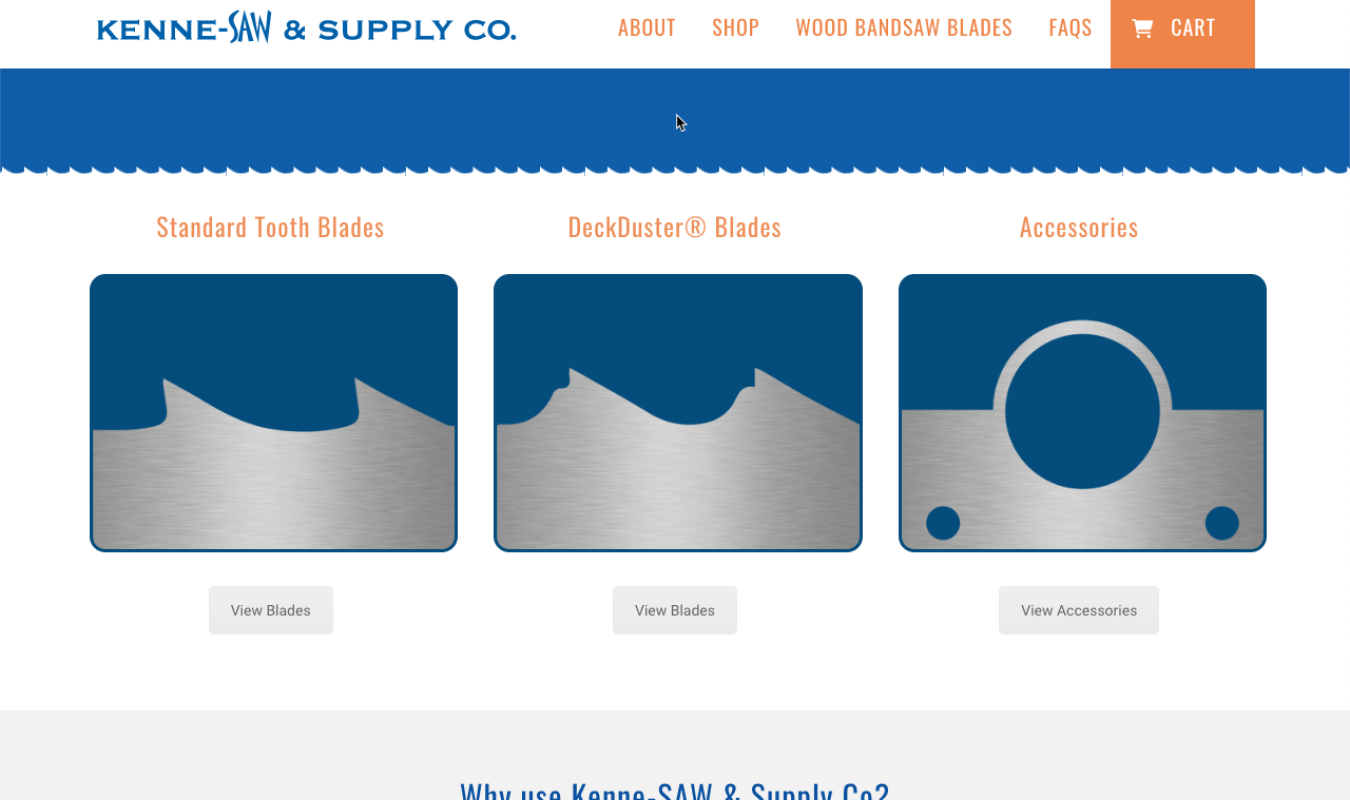
- Standard Tooth Blades
- DeckDuster® Blades (proprietary tooth configuration)
- Accessories (actual inventory items)
Configuration Interface:
Customer-facing blade builder featuring:
Step 1: Blade Width Selection
Visual selector with options:
- Dropdown or button interface
- Clear labeling: “1 inch”, “1-1/4 inch”, etc.
- Help text: “Choose width matching your saw’s capacity”
- Equipment compatibility notes where applicable
Step 2: Blade Thickness (Gauge)
Specification selection:
- Radio buttons or dropdown
- Common gauges prominently featured
- Technical specifications displayed (.024″, .032″, etc.)
- Application guidance: “Thicker = durability, Thinner = less waste”
Step 3: Teeth Per Inch (TPI)
Tooth configuration selection:
- Visual representations of tooth patterns
- TPI number with descriptive labels
- Application recommendations:
- “3-4 TPI: Fast cutting, rough lumber”
- “5-6 TPI: General purpose, pallet manufacturing”
- “7-10 TPI: Smooth finish, precision cutting”
- Hook angle options for advanced users
Step 4: Blade Length
Precise measurement input:
- Feet dropdown (8′ to 30’+)
- Inches dropdown (0″ to 11″)
- Measurement help: “How to measure your saw”
- Link to measurement guide with diagrams
- Tolerance notes
Step 5: Quantity
Order quantity selection:
- Number input field
- Volume pricing display: “Buy 5+, save 10%”
- Total blade footage calculation
- Estimated shipping weight
Real-Time Visual Feedback:
As customers select options:
- Configuration summary panel updating
- SKU code generating and displaying
- Price calculating and updating instantly
- “Add to Cart” button activating when complete
- Specification review before final addition
Technical Implementation:
JavaScript-based configuration logic:
// Simplified example of dynamic SKU generation
function generateSKU(width, thickness, tpi, length_ft, length_in) {
// Convert specifications to SKU components
const widthCode = formatWidth(width);
const thicknessCode = formatThickness(thickness);
const tpiCode = formatTPI(tpi);
const lengthCode = formatLength(length_ft, length_in);
// Construct unique SKU
const sku = `KB-${widthCode}-${thicknessCode}-${tpiCode}-${lengthCode}`;
// Example output: KB-2.0-032-5-180
// 2.0″ wide, .032″ thick, 5 TPI, 15 feet (180 inches)
return sku;
}
Dynamic Pricing Engine:
Backend PHP logic calculating price:
function calculateBladePrice($width, $thickness, $tpi, $length_inches, $quantity) {
// Base material cost
$material_cost = ($width * $length_inches * $thickness) * $steel_price_per_cubic_inch;
// Manufacturing cost addition
$manufacturing_cost = calculateManufacturingCost($tpi, $length_inches);
// Base blade cost
$base_price = $material_cost + $manufacturing_cost;
// Apply margin
$retail_price = $base_price * $markup_percentage;
// Volume discount
if ($quantity >= 10) {
$retail_price *= 0.85; // 15% discount
} elseif ($quantity >= 5) {
$retail_price *= 0.90; // 10% discount
}
return round($retail_price, 2);
}
WooCommerce Virtual Product Integration:
Custom product type extending WooCommerce:
- Virtual product (no inventory tracking)
- Custom meta fields storing configuration
- Dynamic price assignment per cart item
- Unique SKU per configuration
- Order details capturing full specifications
Guided Decision Support System:
Helping Customers Make Correct Specifications:
Recognition that not all customers possess expert knowledge:
Educational Content Integration:
Measurement Guide:
Detailed instructions with diagrams:
- “How to Measure Your Bandsaw for Blade Length”
- Step-by-step visual guide
- Common saw models and their typical lengths
- Measurement tools and techniques
- Video demonstration embedded
Specification Selection Guide:
- “Choosing the Right Blade Width”
- “Understanding Blade Thickness”
- “TPI Selection for Your Application”
- Comparison charts and decision trees
Application-Based Recommendations:
Rather than only specification-based selection, offering use-case pathways:
Pallet Manufacturing:
“Cutting pallet lumber? Try these specs:”
- Recommended width: 1-1/2″ or 2″
- Recommended thickness: .032″ or .035″
- Recommended TPI: 5 or 6
- “Add Recommended Configuration” one-click button
Portable Sawmill:
“Using portable Wood-Mizer or similar?”
- Common configurations for popular equipment
- Model-specific recommendations
- Link to full specification guide
Resawing Hardwoods:
“Precision resawing thick hardwoods?”
- Width for beam cutting
- TPI for smooth finish
- Feed rate recommendations
Equipment-Specific Presets:
Database of common saw models:
- “Select your saw model” dropdown
- Pre-configured width, length, typical TPI
- Customer adjusts from known-good baseline
- Reduces measurement error risk
Validation and Warning System:
As customers configure:
Unusual Combination Warnings:
“You’ve selected 1″ width with 10 TPI. This is uncommon and may not perform well. Consider 5-6 TPI for this width.”
Length Validation:
“This length is outside typical range. Please double-check your measurement. Common lengths are 12-20 feet.”
Incompatible Selection Prevention:
System prevents impossible combinations:
- Certain width/thickness pairings not manufacturable
- TPI limits based on blade width
- Length minimums and maximums enforced
Seamless Cart and Checkout Experience:
Industrial B2B Optimized Purchasing:
Cart Display:
Each configured blade shown with complete specification:
SKU: KB-2.0-032-5-180
Specifications:
– Width: 2 inches
– Thickness: .032″
– TPI: 5 (General Purpose)
– Length: 15 feet 0 inches
Quantity: 5
Unit Price: $87.50
Subtotal: $437.50 (10% volume discount applied)
Easy Reordering:
“Need another blade with different specs?”
- “Configure Another Blade” button
- Returns to configuration interface
- Previous selections remembered as starting point
- Quick iteration through multiple blade types
Quote Request Option:
For complex or bulk orders:
- “Request Quote” button
- Specifications sent to sales team
- Custom pricing for large volumes
- Consulting on specifications
Account-Based Pricing:
Registered business customers seeing:
- Account-specific pricing (negotiated rates)
- Net terms payment options (30-day terms)
- Purchase order number field
- Order history and quick reorder
Production Integration Backend:
Order-to-Manufacturing Workflow:
Order Placement:
Customer completes checkout → System generates:
Order Confirmation Email (to customer)
- Complete specification listing
- SKU codes for each blade
- Expected production timeline
- Order tracking information
Production Order (to Kenne-Saw)
- Detailed manufacturing specifications
- Blade width, thickness, TPI, length
- Quantity required
- Customer shipping information
- Special instructions or notes
Manufacturing Specifications Export:
Order data formatted for production:
Order #12345
Customer: ABC Pallet Manufacturing
Ship Date: 5 business days
Blade 1:
Width: 2.0″
Thickness: .032″
TPI: 5
Length: 15’0″ (180″)
Quantity: 5
Notes: Standard tooth, production pallet cutting
Blade 2:
Width: 1.5″
Thickness: .035″
TPI: 6
Length: 12’6″ (150″)
Quantity: 3
Notes: Precision cutting application
Quality Control Integration:
Each manufactured blade:
- Tagged with order number and specifications
- Quality inspection checklist matching customer requirements
- Length verification (measuring actual welded loop)
- Tooth pattern validation
- Tensioning specification
Shipping Integration:
Packaging specifications auto-generated:
- Blade lengths determining box sizes
- Weight calculations for shipping quotes
- Dimensional freight considerations
- Carrier selection based on destination
- Tracking number assignment and customer notification
WordPress/WooCommerce Technical Implementation
Custom Plugin Development:
“Kenne-Saw Blade Configurator” Plugin:
Standalone WordPress plugin providing all dynamic functionality:
Features:
- Configuration interface shortcode (embeddable on any page)
- Virtual product type registration
- Dynamic SKU generation functions
- Pricing calculation engine
- WooCommerce integration hooks
- Admin configuration panel
- Measurement conversion utilities
Benefits:
- Maintainable codebase separate from theme
- Portable to future site redesigns
- Version controlled and testable
- Documented API for future enhancements
Database Architecture:
Specifications Storage:
Rather than storing products, storing specification rules:
Blade Width Table:
- width_id
- width_value (1.0, 1.25, 1.5, 2.0, etc.)
- display_label (“1 inch”, “1-1/4 inch”)
- sort_order
- active (enable/disable without deleting)
Blade Thickness Table:
- thickness_id
- gauge_value (.024, .032, .035, etc.)
- display_label
- material_factor (for pricing calculation)
- sort_order
TPI Configuration Table:
- tpi_id
- tpi_value (3, 4, 5, 6, 7, 8, 10)
- tooth_pattern (standard, variable, hook angle variants)
- application_notes
- manufacturing_cost_factor
Pricing Rules Table:
- rule_id
- width_range (applicable widths)
- thickness_range
- base_material_cost
- manufacturing_cost
- markup_percentage
- effective_date (pricing updates)
Compatibility Matrix:
- Defines valid width/thickness/TPI combinations
- Prevents impossible configurations
- Guides customer selections
Admin Configuration Interface:
Non-Developer Management:
WordPress admin panel for Kenne-Saw staff:
Specification Management:
- Add/edit/disable blade widths
- Update thickness options
- Modify TPI configurations
- Set compatibility rules
Pricing Updates:
- Material cost input (responds to steel price fluctuations)
- Manufacturing cost adjustments
- Markup percentage control
- Volume discount tiers
- Effective date scheduling for price changes
Product Content:
- Educational guide content editing
- Measurement instruction updates
- Application recommendation modifications
- FAQ management
Order Management:
- View configured blade orders
- Export production specifications
- Order status tracking
- Customer communication tools
Performance Optimization:
Speed Despite Complexity:
Caching Strategy:
- Specification options cached (rarely change)
- Pricing calculations cached by configuration signature
- Compatibility matrix cached in memory
- Page-level caching where appropriate
JavaScript Optimization:
- Configuration interface single-page application
- No page refreshes during option selection
- Debounced price calculation (waits for typing pause)
- Preloaded specification data (one initial request)
Database Query Optimization:
- Indexed tables for fast specification lookup
- Efficient JOIN queries for compatibility checking
- Prepared statements preventing injection attacks
- Connection pooling for concurrent users
Measurable Business Impact
Operational Efficiency:
- Order processing time reduced from hours to minutes
- Sales staff freed from manual order entry
- Error rate decreased from 3-5% to <0.5%
- After-hours ordering enabled (24/7 availability)
- Scalability achieved without proportional staffing
Customer Experience:
- Self-service convenience for repeat customers
- Specification accuracy improved
- Instant pricing eliminating quote delays
- Educational resources reducing decision uncertainty
- Mobile ordering capability
Revenue Growth:
- Online channel creating new customer acquisition
- Geographic market expansion beyond phone reach
- Average order value increase (volume discounts visible)
- Repeat ordering simplified (order history access)
- Cross-selling accessories during checkout
Data Intelligence:
- Customer configuration preferences tracked
- Popular specifications informing inventory decisions
- Geographic demand patterns visible
- Pricing sensitivity analysis possible
- Equipment type trends identifiable
Competitive Advantage:
- First-in-industry custom configuration platform
- Barrier to entry for competitors (technical sophistication)
- Customer switching costs (familiarity with system)
- Brand perception as technology leader
- Consultative selling enhanced by data
Strategic Partnership Value
Complex E-Commerce Expertise:
Code Conspirators brought specialized knowledge solving problems beyond standard platform capabilities—understanding how to architect systems for products that don’t physically exist until customer configuration.
Black Bear Design Collaboration:
Effective partnership with design agency:
- Respecting design vision while implementing technical requirements
- Collaborative problem-solving on UX challenges
- Clear communication of technical constraints and possibilities
- Integrated workflow producing cohesive result
Industrial B2B Understanding:
Recognition that B2B industrial sales differ fundamentally from B2C retail:
- Technical specification requirements
- Educational support needs
- Business purchasing workflows
- Account-based pricing structures
- Production integration requirements
Ongoing Support Partnership:
Long-term relationship providing:
- Technical support and bug fixes
- Feature enhancements as needs evolve
- Pricing engine updates
- WordPress and plugin updates
- Security maintenance
- Performance monitoring
Conclusion
The Kenne-Saw & Supply Co. project demonstrates Code Conspirators’ ability to solve unique e-commerce challenges requiring custom development beyond off-the-shelf platform capabilities. By engineering dynamic product configuration system where products are generated on-demand based on customer specifications rather than pre-existing in database, we helped Kenne-Saw transform complex industrial ordering process into intuitive self-service experience—maintaining specification accuracy while improving operational efficiency.
This wasn’t just e-commerce implementation—it was custom software engineering solving fundamental business problem through innovative technical architecture. The virtual product system handles infinite configuration possibilities, real-time pricing engine provides instant quotes, guided decision support helps customers make correct specifications, and production integration seamlessly connects online orders to manufacturing workflow.
For Kenne-Saw & Supply Co., this platform represents foundation for scalable growth, operational efficiency, and competitive differentiation in specialized industrial market. For customers, it provides convenient self-service ordering with educational support ensuring correct blade specifications for their equipment. And for Code Conspirators, it exemplifies our capability to architect custom solutions for complex business requirements—delivering technical sophistication, usability excellence, and measurable operational improvement.
As Kenne-Saw continues serving sawmill and woodworking industries with precision-manufactured bandsaw blades, their e-commerce platform continues processing custom orders 24/7—enabling business growth without proportional staffing increases and demonstrating that even highly technical industrial products can be sold effectively online when proper custom development addresses unique business requirements.
Key Takeaway: Complex manufactured products with infinite configuration possibilities require custom e-commerce solutions beyond standard platform capabilities. Code Conspirators engineers dynamic product systems with virtual SKU generation, intelligent pricing engines, guided customer decision support, and production integration that transform technical complexity into seamless ordering experiences driving operational efficiency and business growth.